Friday, May 18, 2012

'The Black Knight' by Didier Eberoni
from the May 1982 issue of Heavy Metal


Monday, May 14, 2012

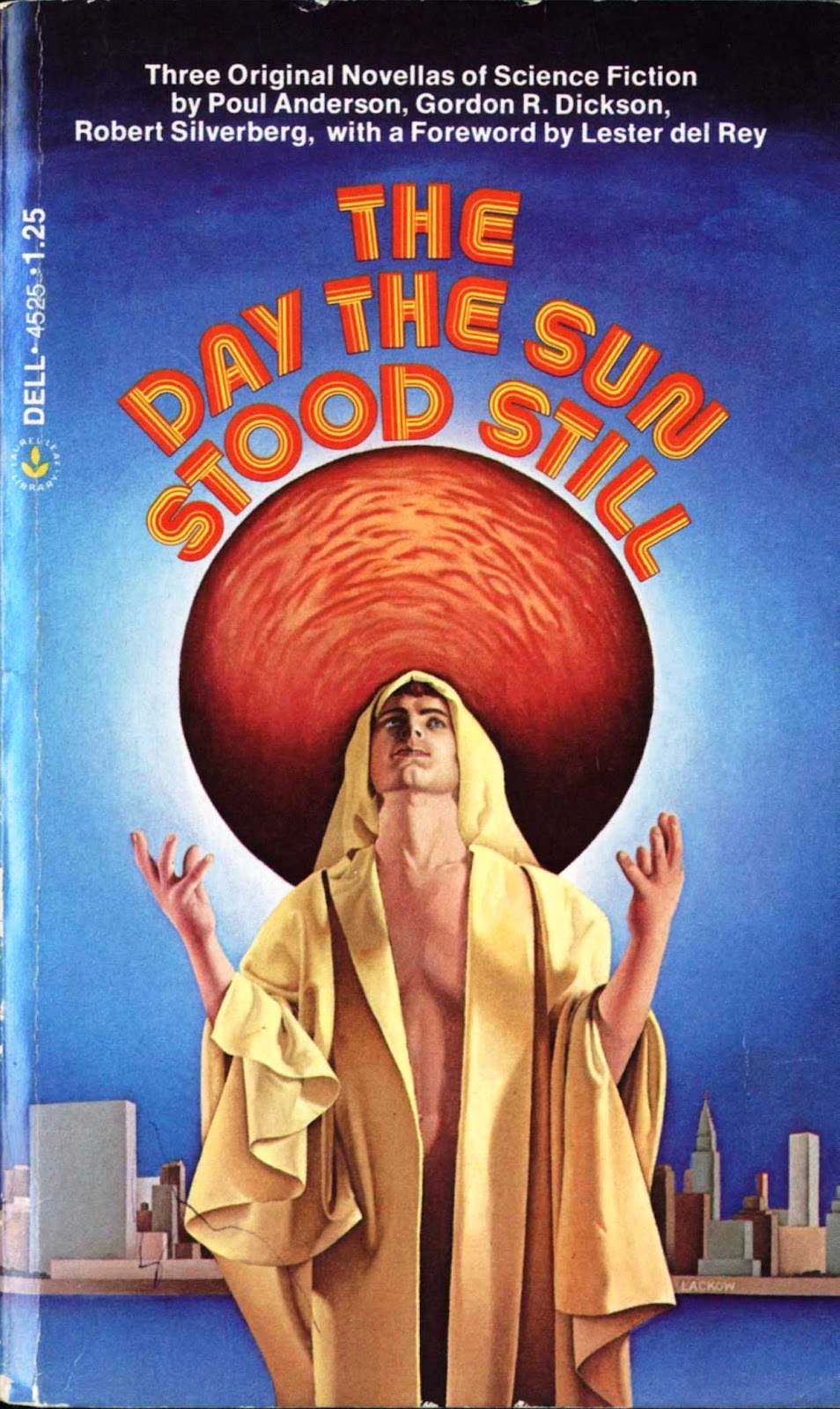
Book Review: 'The Day the Sun Stood Still' edited by Lester del Rey

1 / 5 Stars

‘The Day the Sun Stood Still’ was first published in May 1972 in hardcover. This Dell Laurel-Leaf paperback edition (221 pp.) was published in October 1975; the cover artwork is signed [Andy ?] ‘Lackow’. While Lester del Rey is not listed on the cover as the editor, he did contribute the Forward.

‘The Day’ is a shared-theme anthology devoted to the topic of how the modern world might react to the stopping of the Sun described in some Bible passages, most notably Joshua, chapter 10.

Perhaps because of restrictions on content (Laurel-Leaf was a publication line devoted to Young Adults), the three novelettes all focus less on apocalyptic horrors, and instead center more on the sociological and psychological ramifications of a manifestation of the Creator at a time when ‘God Is Dead’ skepticism is well-entrenched. The stories are more or less set in the year 2000.

Poul Anderson’s ‘A Chapter of Revelation’ starts with the planet trembling on the edge of WWIII, as the US and China face off in the Yellow Sea over the fate of Korea. A middle-aged auto repair shop owner from Oakland, named Louis Habib, goes on television, and urges the world to pray at the same time, on the same day, for Peace.

Miraculously, the Sun stands still for an entire 24 hours as a result of this Moment of Prayer.

The narrative then takes a cynical turn, as religious groups and politicians try to co-opt the bewildered Habib into serving their causes.

Robert Silverberg’s ‘Thomas the Proclaimer’ also features a reluctant Prophet, in this case, a former drifter and con man who finds himself mediating the stopping of the Sun. In the aftermath, global society comes undone, and Thomas struggles with how to exploit his miracle. This tale also has a cynical tenor, as Silverberg takes the attitude that miracles are easy, it’s following up on them that proves a prophet’s hardest task.

The final tale, Gordon R. Dickson’s ‘Things Which Are Caesar’s’ is the weakest entry in the anthology. Over-long and unfocused, the story commences on the eve of the stoppage of the Sun, as Americans from all walks of life descend on a remote campground to await the miracle. 


Most of the ensuing narrative is preoccupied with having the characters engaged in post-miracle philosophical debates about The Meaning of It All. A taciturn onlooker named Ranald, who may be Immortal and a witness to Joshua’s feat, serves as a kind of neutral counterpoint to the mutterings of the modern people gripped by their existential angst. 

The story ends on a rather contrived note, as if author Dickson felt he had to impart some kind of Deep Message to justify his meandering storyline. 

In summary, ‘The Day’ is an unremarkable anthology, with its contributors adopting rather unimaginative approaches to what might have been a provocative topic (in more inspired hands). 

'The Day' is probably most interesting as an indicator of how much more sophisticated a vocabulary junior high and high school students were expected to possess back in the early 70s. 

Silverberg's story includes words like 'schadenfreude' , as well as a list of terms related to religious artifacts, that had me using an online dictionary. Nowadays, I suspect few members of various state Board of Regents English ('Language Arts') faculty would be able to grasp such terms.....

Thursday, May 10, 2012

Heavy Metal magazine May 1982

'Heavy Metal' magazine May 1982


It’s May 1982, and in the Falkland Islands, fighting is underway between the Argentine invaders and the UK.

‘Don’t You Want Me Baby’, by The Human League, is in heavy rotation on the FM dials. Also getting a lot of airplay is the latest single by Genesis, titled ‘Understanding’. 

The May issue of Heavy Metal magazine is on the stands, with a front cover illustration by Corben and Townley titled ‘Spheres’. 

This is one of the few (only ?) HM covers to feature a fully clothed woman in a decidedly demure stance. 

The back cover is ‘The Detour’, by Moebius.

This is a good issue of HM, although the large number of text pieces is a surprise, in light of the dismissal of former editor Ted White in 1981, ostensibly for upping the magazine’s text content.

The ‘Dossier’ section is not only five pages long but it’s relocated to the first pages of the issue (just after a striking full-page ad for the latest Scorpions album, and another ad for the upcoming ‘Conan’ movie).

The Dossier has some interesting columns, including a scathing review of the latest (i.e., ‘Best of 1981’) SF anthologies by Bruce Sterling.


As of May ’82, the cyberpunk movement (although no one called it that) was just starting to get underway, and Sterling was known as the author of the promising novels ‘Involution Ocean’ and ‘The Artificial Kid’. The impatience of Sterling and the other proto-cyberpunks had with the sf establishment, and its increasingly lifeless approach to writing, is on clear display in his reviews of these anthologies.

Other columns deal with the revival of pop culture interest in the Third Reich and the Nazis; a review of the film ‘Quest for Fire’; a new biography of rocker David Bowie; and a look at the Avalon Hill board gaming universe.

A comic by B. K. Taylor, ‘War Games’, is a laugh-out-loud look at geek culture back in the early 80s.


One of the stranger entries in this issue is a three-page essay by one David Black, titled ‘The Third Sexual Revolution: Transcendent Eroticism in the Eighties’. Author Black predicts that the availability of video porn will energize 80s couples into pursuing Tantric Practices (!). 

Whether Black’s predictions came true or not (with the exception of Sting), is unclear. What makes ‘Third Sexual Revolution’ interesting is the absence of any mention of AIDS, which in May 1982 was known as GRID (gay – related immune deficiency), something which infected 'homos, hemophiliacs, Haitians, and heroin users'. 

Ahh, those innocent days....


In terms of its graphic content, the May issue featured ongoing installments of ‘The Incal Light’, ‘Den II’, ‘Nova II’ , ‘Zora’, ‘Yragael’, and ‘At the Middle of Cymbiola’, while Segrelles’ ‘The Mercenary’ closed out with its final episode. 

A number of good one-shot strips are featured, and one of the best, as always, is by Caza. I’ve posted ‘Exiled’ below.


Tuesday, May 8, 2012

Code Name: Slaughter Five from Eerie magazine

'Code Name: Slaughter Five'
from Eerie No. 70, November 1975

A downbeat 'overpopulation' horror tale, with art by Leopold Sanchez and story by Gerry Boudreau, and a vintage 'Soylent Green' sensibility.....


Saturday, May 5, 2012

Book Review: To Stand Beneath the Sun

Book Review: 'To Stand Beneath the Sun' by Brad Strickland 
3 / 5 Stars

‘To Stand Beneath the Sun’ (256 pp.) was published in April, 1986 by Signet / NAL; the cover artist is uncredited.

‘To Stand’ belongs to the sub-genre of sf in which a spaceman finds himself marooned (or imprisoned) on a planet where the sex roles are reversed, with womyn as the rulers and men relegated to a second-class status. Other examples of this approach include Cynthia Felice’s ‘Double Nocturne’, David Brin’s ‘Glory’, and Linda Steele’s ‘Ibis’.

The premise of ‘To Stand’ involves a colony starship named the Galileo, launched 5,000 years previously from a depleted and desperate Terra. The starship’s crew and passengers are in stasis until the ship reaches a suitable destination. 


However, while still short of its original destination, a malfunction sends the ship into orbit around an earth-like planet named Kalea. A portion of the ship’s stasis chambers are jettisoned down onto the planet below, and those passengers who survive the landings establish a colony, albeit one endowed with a medieval level of technology. 

As the narrative commences a geologist named Tom Perion, still in stasis within his chamber aboard the Galileo, is abruptly ejected from the ship; his chamber splash-lands in the oceans of Kalea, where, by good fortune, a sailing ship rescues him.

Perion is bewildered to learn that his rescuers are an all-female crew. It turns out that in the 1700 years since the arrival of the first colonists jettisoned onto the surface of Kalea, various sociological and demographic events have combined to render the population skewed towards a preponderance of women. 


Men are considered too precious to engage in traditionally manly pursuits, and are relegated to lives as sybarites, tasked with the not altogether disagreeable duties of fathering children from rotating harems of shapely young women.

Author Strickland doesn’t veer into Gor Fanboy territory, and keeps his narrative centered on Tom Perion’s efforts to find a place in this female-dominated society, and to rescue the Galileo, still circling Kalea, albeit in a dangerously low orbit.

Perion’s hopes rest on discovering if other stasis pods, landed elsewhere on the planet, have functioning electronics that will allow him to contact the mother ship, revive its crew, and import the ship’s technology into the increasingly fractious society ruling Kalea.

But, not only does the stranded spaceman have to convince his skeptical female rescuers that the ‘Silver Star’ crossing the heavens each night is in fact a spaceship, built and flown from a planet light-years away, but Perion’s entanglement in a conflict between rival trade houses triggers a blood feud.

Can TPerion find an intact stasis pod amid the inhospitable wastes of northern Kalea ? And will he reach the pod before a team of mercenaries finds, and eliminates, he and his female companions ?

‘To Stand’ is a very readable sf novel. Main character Tom Perion, while subject to occasional moments of poor judgement, maintains a necessary self-deprecating attitude even as he maneuvers his female overseers into complicity with his plans to contact the Galileo


While the middle segments of the novel tend to drag a bit, as author Strickland gives way to overlong exposition on various details of Kalean society, the latter third of the novel consists of a prolonged, well-paced chase sequence.

‘To Stand Beneath the Sun’ is worth picking up from the used book shelves.

Thursday, May 3, 2012

'Superhero' by Angus McKie
from the May 1982 issue of Heavy Metal


Tuesday, May 1, 2012

'The Bus' by Paul Kirchner