SO....what's a PorPor Book ?
'PorPor' is a derogatory term my brother used, to refer to the SF and Fantasy paperbacks and comic books I eagerly read from the late 60s to the late 80s.
This blog is devoted to those paperbacks and comics you can find on the shelves of second-hand bookstores...from the New Wave era and 'Dangerous Visions', to the advent of the cyberpunks and 'Neuromancer'. And with a leavening of pop culture detritus, too !
‘Globalhead’ was published in hardcover in 1992; this Bantam Spectra mass market paperback edition (340 pp.) was released in November 1994. The cover artwork is by Bruce Jensen.
With the exception of ‘Are You For 86 ?’, all the stories in this compilation were previously published from 1985 – 1992, in magazines such as Omni and Isacc’s Asimov’s Science Fiction Magazine. My concise summaries of the contents:
Our Neural Chernobyl: short, but well-written, tale about gengineering gone awry. A subtle twist at the end caps the story off perfectly.
Storming the Cosmos: a collaborative effort with Rudy Rucker. A dissipated KGB informer accompanies a scientific team to the Tunguska meteorite site. Mayhem and hijinks ensue. Rucker’s participation gives this story a dose of absurdist humor, moreso than a standalone Sterling tale.
The Compassionate, the Digital: the Iranian Revolution spreads to a worldwide AI. A bit too vague to be fully effective.
Jim and Irene: a dissipated hackersets off on an existential road trip; he is accompanied by a neurotic Russian immigrant named Irene.
The Sword of Damocles: lame effort at re-telling the Greek myth, using a 90s ‘hipster’ vernacular.
The Gulf Wars: Babylonians Vs Persians, through the centuries.
The Shores of Bohemia: uneven tale of an enclave of the future determined to stick to its anachronisms, despite outside pressures. The nanotech component underlying the story is too contrived to be very effective.
The Moral Bullet: in an anarchic, near-future USA, Sniffy the chemist tries to elude forces anxious to punish him for upending modern civilization. One of the better entries in the collection.
The Unthinkable: brief tale about a Cold War waged with Eldritch Knowledge. Crisp and imaginative; another of the Sterling’s best short stories.
We See Things Differently: A representative of the Islamic World Ascendant investigates socio-cultural upheaval in the USA.
Hollywood Kremlin: smuggler Leggy Starlitz negotiates the treacherous political and economic landscape of post-Soviet Azerbaijan. Dark humor pervades the story.
Are You for R86 ? : Leggy returns; this time he’s in the USA, aiding a team of feckless young women (activists named Vanna and ‘Mr Judy’) who are intent on mass distribution of the banned birth control pill RU486. The evangelical Christian community is determined to stop them – by nonviolent means, of course. Plenty of satiric humor makes this another of the better entries in the collection. Leggy’s adventures continued in Sterling’s 2001 novel ‘Zeitgeist’.
Dori Bangs: ‘what if’ rock critic Lester Bangs avoided suicide in 1982, and instead hooked up, in a drugged-out, burnt-out way, with a dissipated Goth Girl who draws self-referential ‘progressive’ comics. Even if you (for some strange reason) are a diehard Lester Bangs fan (which I am assuredly not) the concept of this story seems really lame.
The verdict ? ‘Globalhead’ is a collection of Sterling’s misses, rather than hits. Unlike other Sterling anthologies (‘A Good Old-Fashioned Future’), more than a few of the entries in ‘Globalhead’ seem phoned-in. But this anthology remains the most affordable way (at present) to get hold of gems like ‘The Unthinkable’.
‘Kiteworld’ was published in 1985 in the UK by Gollanz; this Ace mass market paperback edition (293 pp.) was released in the US in May, 1988, with cover artwork by Blas.
‘Kiteworld’ contain several stories that first appeared in Interzone magazine in the early 1980s, as well as, apparently, some newly-written chapters Roberts produced to bring the overall collection to book-length.
‘Kiteworld’ is set in a future Britain, where, in the aftermath of a vaguely described catastrophe – perhaps a nuclear war – civilization endures, albeit in a rural landscape where technology is at a level ca. 1910.
Within this ‘Realm’, a rebooted Christian Church occupies the position of power, mainly by guarding the populace from incursions by ‘demons’ (i.e., mutants) originating within the fallout zone bordering the Realm. The Church has few scruples about using severe penalties – including execution – to restrict technological advancement, impede the acquisition of historical knowledge (such as maps), and punish dissent from its theologies.
As part of efforts to deter the ‘demons’ from trespassing into Realm space, the Church sanctions the use of large, man-carrying kites. These are regularly launched aloft, there to float for hours displaying ‘hex’ signs and symbols designed to repel demons. Those who man the kites are highly regarded in Realm society, but the mortality rate for kite flyers is high, and an innate fatalism rules their lives.
The stories in ‘Kiteworld’ follow the adventures of a group of recurring characters who man the kite stations, and dwell in the small towns, that occupy the outer districts of the Realm. The novel’s sf elements are muted, and serve mainly as a background against which author Roberts explores themes such as the tensions between orthodoxy and dawning humanism (a theme which he visited in his 1968 novel 'Pavane').
The writing style Roberts employs in Kiteworld is of mixed effect. While there are many descriptive passages, their focus on incidental details often fails to enlighten the reader; for example, the grease, smell, and manipulation of the kite-launching gear is fulsomely presented, but clear descriptions of the kites and the principles of their flight are deliberately vague. As well, I often was frustrated by Roberts's use of dialogue laden with British colloquialisms, slang, and figures of speech to impart important plot details in an oblique, inferential manner.
That said, as with Pavane, Roberts makes the world of the Realm more ‘real’ than many contemporary, 800-page fantasy novels, burdened by highly descriptive prose, struggle to achieve with their own imagined landscapes.
The action picks up in the last chapters of the novel, but unfortunately, Roberts elects to close on a contrived note.
‘Kiteworld’ will most appeal to those readers with the patience to sit down with a slower-paced narrative that centers on the trials, tribulations, and hopes of its characters. Those looking for a action narrative, with proto-steampunk sensibilities, are better off passing.
'Race of the Damed' by Norman Mundy, Carey Bates, and Buz Vault from Eerie #109, February, 1980
By 1980, the Warren magazines had become increasingly aware of the artistic influence of Heavy Metal magazine, as this art deco - inspired comic shows.
August, 1983, and in heavy rotation on the FM stations, and on MTV, is Loverboy's 'Hot Girls in Love'. Cheesy as it was back then, it's substantially better than anything in the top 40 nowadays.
The latest issue of Heavy Metal is on the stands, with a remarkably insipid front cover illustration by Greg Hildebrandt. It was now becoming quite clear that the HM editorial staff had decided to exclusively promote a pinup theme for each and every front cover, a departure from the way things were done in the first several year's of the magazine's existence. The arresting, artistic covers of 1978, 1979, and 1980 were to be faint memories from now on.
Jay Muth provides the back cover.
The advertising features a full-page ad for the latest Iron Maiden album, 'Piece of Mind'; it's an unwitting and unintentional nod to 'Spinal Tap'.
For those deeply moved by the Hildebrandt cover, posters are available:
There also is an advertisement for some film I've never heard of, called 'Private School for Girls'. Phoebe Cates does look nice.....
After its heavy coverage of rap, the Dossier now turns to R & B, and we lead off with coverage of Prince Nelson Rogers (just beginning his rapid rise to fame), and Marvin Gaye.
Then there is coverage of graffiti artist - if that's the right word - Keith Haring, one of the decade's greatest art poseurs. He would die from AIDS in 7 years.
Ed Naha waxes enthusiastic over an indie, low-budget film-maker named Alan Arkush and his film 'Get Crazy'. I've never heard of it before or since......
And the Dossier closes out with a review of some awful underground / indie comics.....
Among the comics appearing in the August issue are continuing installments of 'The City That Didn't Exist', by Bilal; 'The Odyssey' by Navarro and Sauri; 'Zora' by Fernandez.
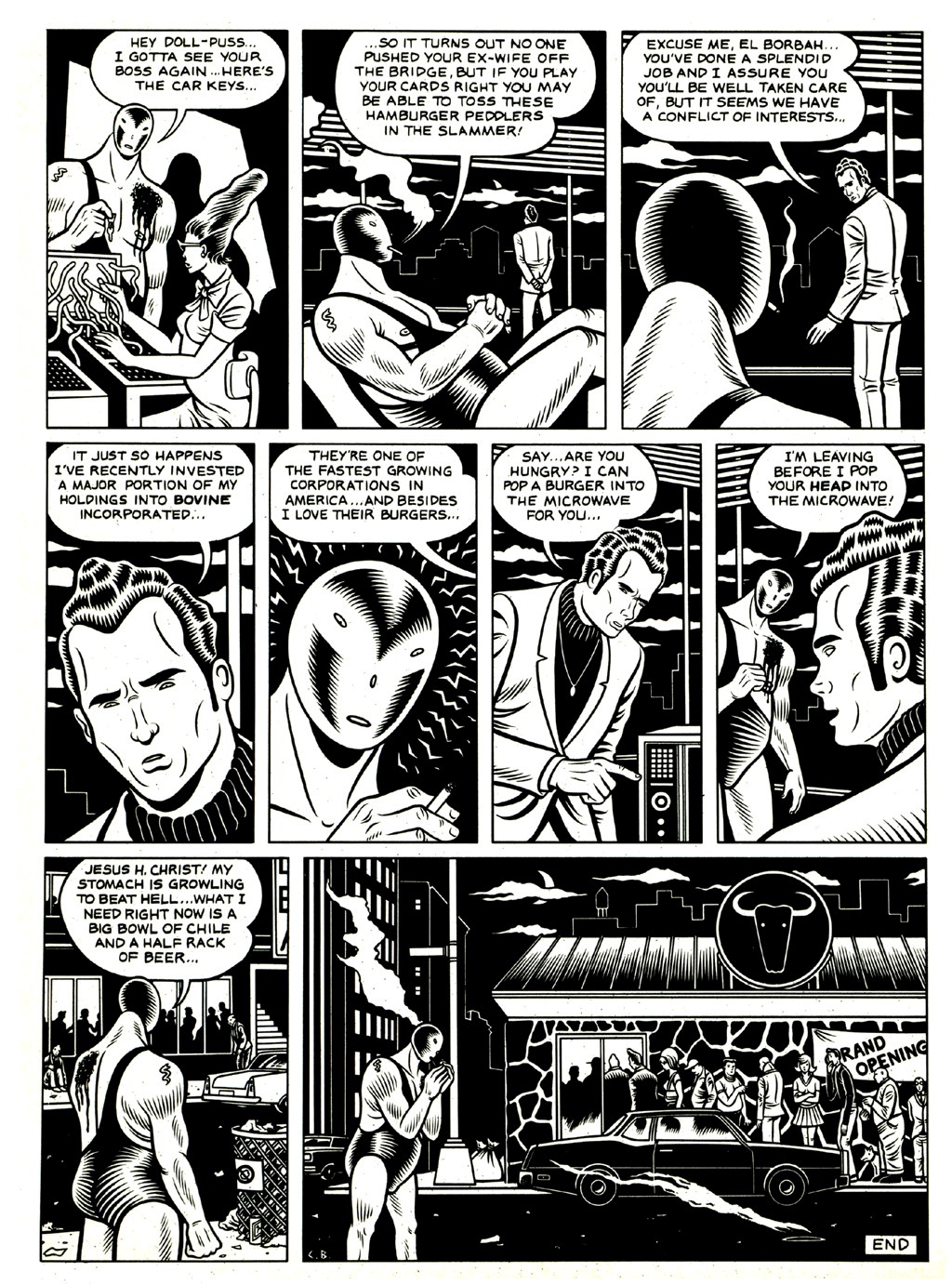
Among the better entries was another 'El Borbah' tale by Charles Burns, that I've posted below.




.jpg)


.jpg)