SO....what's a PorPor Book ?
'PorPor' is a derogatory term my brother used, to refer to the SF and Fantasy paperbacks and comic books I eagerly read from the late 60s to the late 80s.
This blog is devoted to those paperbacks and comics you can find on the shelves of second-hand bookstores...from the New Wave era and 'Dangerous Visions', to the advent of the cyberpunks and 'Neuromancer'. And with a leavening of pop culture detritus, too !
Zenobia written by Bhob Steward, art by Shawn McManus, colors by John Coffey from Zona 84 1985 Annual
'Zenobia' first appeared in the June, 1983 issue of Heavy Metal. It was reprinted in Zona 84, the Spanish counterpart to Heavy Metal. John Coffey's brilliant candy-based color scheme works perfectly with Bhob's script, and its sinister final twist.
Book Review: 'The Empire of Fear' by Brian Stableford
4 / 5 Stars Before there was Kim Newman and Anno Dracula, Guillermo Del Toro and Chuck Hogan and The Strain, and Justin Cronin and The Passage, there was The Empire of Fear. First published in hardback in 1988, this Ballantine Books paperback edition (470 pp) was released in October 1993. The cover artist is uncredited. 'Empire' is set in the 17th century, in a world where Attila the Hun was transformed into a vampire, and then, in turn, converted selected kings and princes into vampirism. The result is that the ruling heads of Europe and Asia are not only centuries old, but surrounded by courtiers and flatterers who hope to trade their servility for the rarely bestowed gift of long life (if not immortality itself). The vampires of Stableford's novel are not the world-destroying, blood-ravenous creatures of the Del Toro and Cronin novels, but rather, fashionably bored aristocrats who need only take small sips of blood from their human victims. However, these vampire kings and princes are ever-ready to use sadistic violence to maintain their grip on the human cattle they rule. Aided by bands of vampire knights (whose resistance to pain, and ability to quickly heal from even grievous wounds, makes them formidable troops in combat) the vampires won't hesitate to imprison, torture, and execute any humans who seek to upend the social order. As the novel opens the young English scientist Noell Cordery has dedicated himself to the overthrow of King Richard the Lion-Heart and his court. Secreted in a monastery in Wales, Cordery researches what little data is available on the condition of vampirism in the hope that he may learn the closely held secret of how new vampires are made, a secret that he hopes to use to the disadvantage of the vampires. But Cordery will not be left undisturbed to consult his books and parchments. A new era of independent thought and action is gradually coming to the human population of Europe, and with it, a growing threat to the stability of vampire rule. A hazardous journey into the unexplored interior of Africa will bring Noell Cordery to the truth underlying the myths and legends of vampirism.........but will he survive long enough to be able to use that knowledge to free Europe from the rule of the vampires ? I remember reading 'Empire' when it first came out and concluding it was a solid four-star novel. Upon re-reading it, I reach the same conclusion. Not so much a horror novel as an alternate history novel, 'Empire' relies on actual historical events to underpin the narrative. The logic governing vampirism that Stableford introduces in the latter pages of the book is novel, but believable, as is Stableford's decision to render the vampires of his book more a class of mutants than the supernatural creatures of traditional vampire lore. Where 'Empire' loses a chance for a five-star rating is in its static quality. Passages of action are few and far between in its pages; Stableford regularly uses lengthy passages of dialogue and internal monologues to discourse on metaphysical and philosophical questions, through which the main theme of the novel is overlaid: namely, the rise of Humanism and scientific inquiry as the alternatives to the superstition and feudalism that have aided and abetted the rule of the vampires, and crippled man's ability to rise against his oppressors. If you are in the mood for a long and contemplative novel that offers a 'scientific' take on the legend of vampirism then you're likely to enjoy The Empire of Fear. However, those looking more for the blood-and-staking excitement of a novel like John Steakly's VampireS probably will not find 'Empire' all that rewarding.
Heavy Metal Preview from National Lampoon March 1977
Here's a blast from the Pop Culture past: in its March, 1977 issue National Lampoon offered a nine-page preview / advertisement for the very first issue of Heavy Metal magazine, appearing on stands that same month. The preview includes copies of September 1976 correspondence between Leonard Mogel, President of the National Lampoon; Matty Simmons, the Lampoon's Chairman; and Editor Sean Kelly, revealing their decision to produce an American version of Metal Hurlant. Because, as Kelly states in his letter, 'the people who like the NatLamp would love Heavy Metal '. Here's where it all started, back in 1977. Toss aside those Marvel comics and Warren magazines and fire up a joint: something New is coming...............!
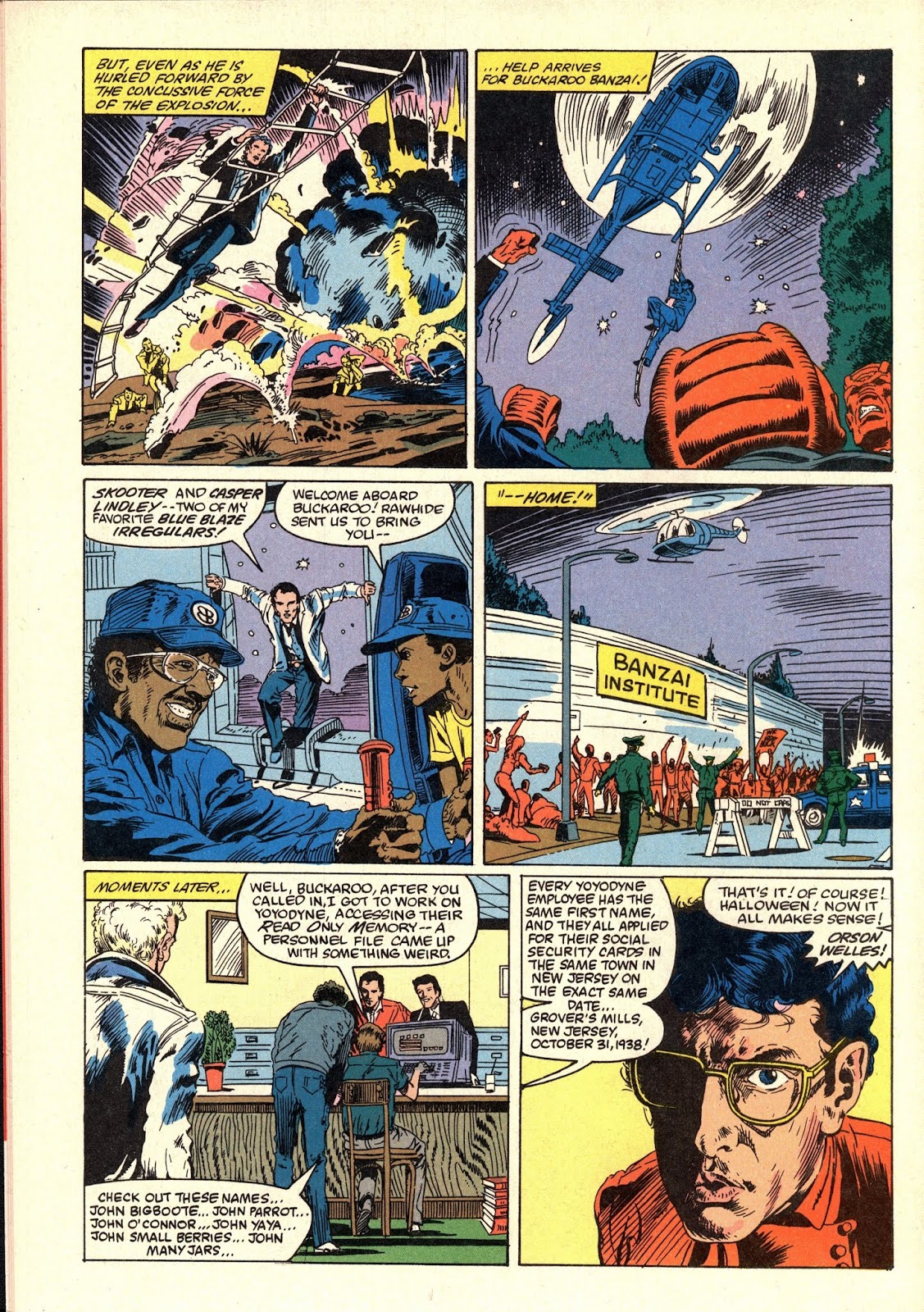
Buckaroo Banzai Official Comics Adaptation Bill Matlo (writer) and Mark Texeira and Armando Gil (art) Part One Marvel Super Special No. 33, 1984
I can't call The Adventures of Buckaroo Banzai Across the 8th Dimension all that great a science fiction film, nor one of the better films of the 80s. When I first watched it when it came out in the late Summer of 1984, I though it was so ardent in its campiness that it would up being incoherent. Even today when it comes on TV I can't bring myself to sit down and watch it from the opening credits to the ending, although I will make the effort to view selected segments of the film - such as the immortal scene with Penny Priddy at Artie's Artery ('No matter where you go, there you are') and the march by the cast through the Los Angeles storm drains shown in the closing credits. The Marvel Super Special that provided a comic-book adaptation of the movie is an easy read, and makes the film's plot coherent, which is no small thing. I'm going to post the entirety of the comic adaptation as a two-parter; Part One is below. If there is interest, I'll also post the 'making of' pictorial essay that was included in the Super Special...............?




.jpg)


