Thursday, May 26, 2011

Heavy Metal magazine May 1981

'Heavy Metal' magazine May 1981


The May, 1981 issue of 'Heavy Metal' features Enrich's 'Enter Adam' on the front cover, and 'Cody Starbuck' by Howard Chaykin on the back cover.

This issue starts off with a two-page short story by William Burroughs titled 'Immortality'. It has something to do with cloning. It's not very good.

Also featured are ongoing installments of 'Bloodstar' by Corben, 'Tex Arcana' by Findley, 'Valentina' by Crepax, and (it just won't go away) 'Changes' by Howarth.

New pieces in this issue include the illustrated story 'Cody Starbuck' by Chaykin, 'The Immortal's Fete' by Bilal, and an interesting portfolio consisting of photographs of miniature sculptures fashioned by Dzintars Mezulis, a Latvian artist. These sculptures are very clever and date from a time before the whole SF and fantasy figurine (i.e., toys) market expanded into the juggernaut that it is today.

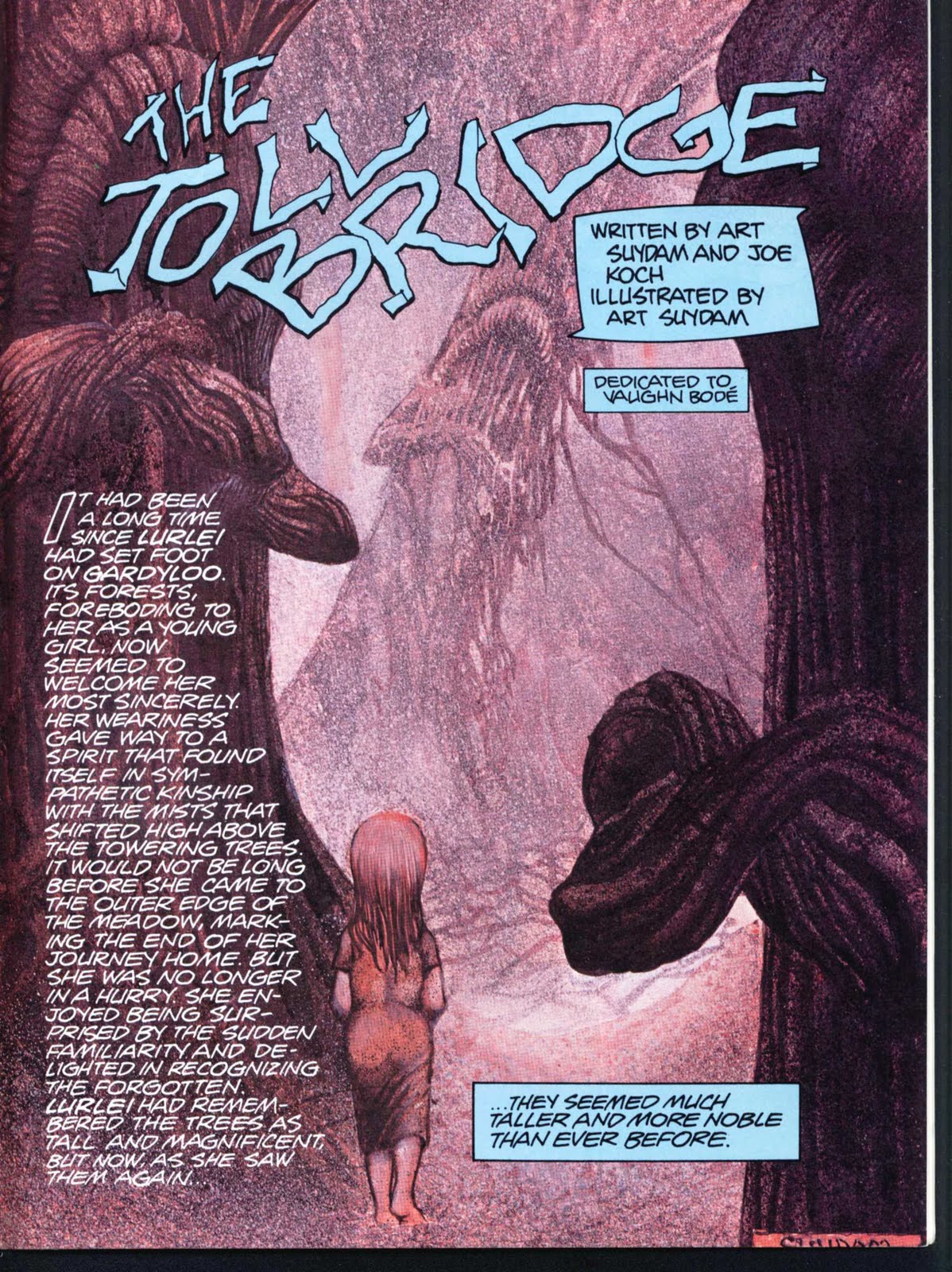
The best entry in the issue is one by Arthur Suydam, 'The Toll Bridge', which introduces his 'Mudwog' character. As always, great artwork and offbeat humor.


Sunday, May 22, 2011

Killraven Amazing Adventures No. 37

Killraven: 'Amazing Adventures' No. 37
(July 1976)


‘Amazing Adventures featuring War of the Worlds’ issue No. 37 (July 1976) shows a franchise running out of steam. This episode, written by Don McGregor and illustrated by Craig Russell, is titled ‘Arena Kill’, and reveals the story of Killraven’s faithful companion Old Skull. Old Skull had a troubled childhood (needless to say) and wound up a gladiator in the Arena, fighting for the amusement of the Martian overlords. He and Killraven are teamed up to battle ‘Warr’, who employs a group of mutant spiders to aid him in his Arena contests.

Russell’s artwork is, as ever, quite capable in depicting the battle, but McGregor can’t resist overlaying too many panels with dialogue….and ending a life-or-death combat with a cutesy interlude involving a drunken raccoon....?! Even in the more innocent days of the mid-70s Marvel titles, the cheese is a little too much.

With only two more installments remaining, the Killraven franchise was on its way out the door; the only question was, how great of a sendoff it would receive……. 


Thursday, May 19, 2011

Book Review: Protostars edited by David Gerrold

Book Review: 'Protostars' edited by David Gerrold


2 / 5 Stars

‘Protostars’ (271 pp.) was published by Ballantine in 1971; the cover artwork is by Gene Szafran.

David Gerrold came on the SF scene in the early 70s and since that time has enjoyed considerable success as a writer and editor of both his own work, and work for licensed properties. [His 1973 book ‘The World of Star Trek’ was really the first 'Bible' for Trekkies.] 

‘Protostars’ is unapologetic New Wave sci fi, and about as representative an example of the genre as any other anthology of the era. 

Each of the stories – which are new and never previously published -  gets a rather pretentious introduction by editor Gerrold, who imparts various anecdotes and bits of wisdom about Being A Writer.

My review of the contents:

‘What Makes A Cage, Jamie Knows’ by Scott Bradfield: a short-short by teenager Bradfield; calls to mind a ‘Twilight Zone’ episode.

‘I’ll Be Waiting for You When the Swimming Pool is Empty’ by James Tiptree: in his intro to this story, editor Gerrold remarks that he can’t find any information about the mysterious James Tiptree, who communicates solely through a P.O. Box in MacLean, Virginia. Not until 1977 would the SF world know that  ‘Tiptree’ was the pseudonym of Alice Bradley Sheldon. ‘Swimming Pool’ is a satirical tale of a well-meaning hippie who arrives on a backwater planet with the most earnest of intentions.

‘In A Sky of Daemons’ by Larry Yep: a textbook example of the stylistic excesses of so many New Wave authors: characters identified by all caps (‘SHIVA’), italicized passages denoting Inner Musings, awkward switches in the narrative POV from first to third person, philosophical conversations with a sardonic AI that rules the world, etc., etc.

‘The Last Ghost’ by Stephen Goldin: in a formless Void, the spiritual essence of a recently deceased woman encounters that of a man in the grip of Angst and Anomie. Goldin also contributes the short-short story ‘The World Where Wishes Worked’, a fable with a trick ending.

‘Afternoon With A Dead Bus’ by David Gerrold: nature red in tooth and claw on the streets of the city. 

‘Eyes of Onyx’ by Edward Bryant: one of the better entries in the collection, a downbeat reworking of a Bible story set in a bleak, near-future LA.

‘Cold, the Fire of the Phoenix’ by Leo P. Kelley: things could get really embarrassing when a ‘mainstream’ SF author decided to embrace the New Wave movement, and did so via a story or novel that slavishly incorporated every artifice the Movement epitomized. This story is a great example. It’s the worst in the anthology.

‘Oasis’ by Pamela Sargent: a man with a unique ability – or curse - strives for solitude in the Sinai desert. While the underlying theme is not all that original to SF, author Sargent handles it well, and this is another of the better entries in the anthology.

‘Holdholtzer’s Box’ by David R. Bunch: a fable about human self-discovery; unremarkable.

‘The Five-Dimensional Sugar Cube’ by Roger Deeley: with the help of metaphysics, Boy Meets Girl. Lightweight, but not unrewarding, due to the presence of a red-haired swingin’ 70s chick.

‘And Watch the Smog Roll In’ by Barry Weissman: dark satire of a near-future California in the grip of toxic pollution, and a bureaucracy gone amok (rather uncomfortably close to the current reality).

‘Chances Are’ by Alice Laurence: editor Gerrold gives this slight tale (about a woman in a coma) five pages of introductory discussion. In the New Wave era, self-important, bloviating intros were part and parcel of many anthologies…..

‘The Naked and the Unashamed’ by Robert E. Margroff: satirical tale of near-future campus protests;  very early 70s in tenor.

‘My Country, Right or Wrong’ by andrew j. offutt: (no typos, spelling one’s name in lowercase was a ‘hip’ affectation for New Wave authors). This is a competent tale of a time traveler who goes from 1978 to 2078, and doesn’t like what he sees.

‘Side Effect’ by Pg Wyal: in this story’s introduction editor Gerrold assures us that author Wyal is indeed a real person, ‘a quiet-voiced…thoughtful individual’ who works in the offices of ‘Crawdaddy’ magazine (a smarmy 70s rock music mag), and someone who doesn’t much like to rewrite his stories (not a good sign). Nonetheless, according to Gerrold, ‘Side Effect’ is one of the best pieces in ‘Protostars’. 

In ‘Side Effect’ author Wyal does what so many New Wave writers did so frequently and so successfully: he blatantly copies William Burroughs’s prose style, an action calculated to turn New Wave editors like Gerrold into helpless, servile putty in one's hands……..

Saturday, May 14, 2011

'Flight Back' by Pepe Moreno
from the April 1981 issue of Epic Illustrated


Tuesday, May 10, 2011

Interview with P. Craig Russell
(from the October 1982 issue of Epic Illustrated)

Craig Russell did much of the artwork for the later issues of the Amazing Adventures / War of the Worlds / Killraven series, as excerpted here at the PorPor Books Blog.

The interview is from the pages of the October 1982 issue of Marvel's 'Epic Illustrated', featuring an 'Elric' story illustrated by Russell. Russell provides some interesting observations on comic art, working with writers on titles for Marvel, and his forthcoming single-shot, 40-pp Killraven book (which Marvel released as a graphic novel in 1983).


Saturday, May 7, 2011

Arthur Suydam's 'Mudwogs'
from 'Echo of Futurepast' issue 4

A bedtime story featuring an unpleasant incarnation of Humpty-Dumpty.

Suydam's artwork in this comic is outstanding, calling to (slightly warped) mind Arthur Rackham, Edmund Dulac, or Maxfield Parrish. 

The double-page spread of pages 24 and 25 must have taken Suydam over a week of careful draftsmanship and coloring to complete. The detail (below) of the fat woman scooping egg into her mouth, including the bracelets on her wrist, the ruffles of the sleeves of her dress, and the vertical slats of the back of the chair she is sitting in, gives some idea of the careful penmanship at work here.


Thursday, May 5, 2011

Two paintings by Robert Williams


" Bedroom eyes, Party Gags, and Graveyard Demeanor"


"Strong Mezcal with Incendiary Chaser"

From Visual Addiction: The Art of Robert Williams, Last Gasp, San Francisco, 1989

Tuesday, May 3, 2011

Book Review: 'Space Viking' by H. Beam Piper

 1 / 5 Stars

‘Space Viking’ (243 pp.) was originally published in 1962 as a serial in the digest magazine ‘Analog’; this Ace paperback apparently was released in January 1977, and features a cover illustration by Michael Whelan.

In the far future, the Federation has collapsed, and the human-colonized worlds each stand and survive on their own. Some have loosely organized themselves into ‘Sword Worlds’, which send forth armed ships manned by ‘Space Vikings’ to raid and plunder other planets.

On the Sword World of Gram, Lucas Trask, an affable young man, looks forward to marrying his fiancée and living a comfortable life as a mid-level aristocrat. However, Andray Dunnan, a deranged former suitor of his wife-to-be, the Lady Elaine, crashes the wedding ceremony. Dunnan kills Elaine and seriously wounds Trask before escaping off-planet in a commandeered raiding ship.

Recovered from his wounds, Lucas Trask has thoughts only for revenge. He joins with Admiral Harkaman, an experienced Space Viking, on a quest to find Dunnan wherever he is hiding in the vastness of explored space. If that quest requires the plundering and destruction of hapless planets, so be it, for Lucas Trask is a man on a mission of vengeance. 

However, Andray Dunnan is not one to sit and wait for doom to come upon him…..and inevitably the fleets of pursuer and pursued will clash in battle.

Even by the rather forgiving standards of early 1960s SF, ‘Viking’ is a pedestrian effort at a space opera. The novel’s pacing starts to slow after the opening chapters as author Piper increasingly uses the standard-issue 'revenge' trope to fuel his labored musings on political theory and the decline and fall of civilization. 

The novel’s dialogue has the rather juvenile character of SF writing at the time. Damaged ships are ‘….leaking air and water vapor like crazy’, and more than a few passages can politely be called Wooden:

“I know, Prince Trask; you have no reason to think kindly of King Angus – the former King Angus, or maybe even the late King Angus, I suppose he is now- but a bloody-handed murderer like Omfray of Glaspyth….” 

‘Space Viking’ is best left forgotten as one of a large number of formulaic stories and fix-ups published by Analog during the late 50s and early 60s. 

Don't be fooled by the snazzy Star-Wars era packaging Ace books used to market this obsolete clunker as a masterpiece of modern SF.